A weekly report from ComplianceSME
Global Fuel Report
A new issue every Friday. £10 a month.
The most complete global fuel report available, built on official feeds read directly at the source.
Every Friday you get one dated file that tells you the state of the world's fuel supply: what is running, what is broken, what it costs, and what changed in the past seven days. It is read out of 43 official feeds published by governments, grid operators, statistics offices and energy regulators. Every figure in the issue carries the name of the source it came from and the date it was published.
Two status boards carry 136 named refineries and pipelines, one line each, with the condition of the asset, the evidence behind that condition, and a repair estimate where one has been stated publicly.
Every issue also carries a block headed What this issue could not see, and why. Anything that could not be read that week is named there, by feed, with the reason.
£10 a month
Every issue, and every back issue, downloaded from your account.
Subscribe, £10 a monthIncluded in every paid account level.
Read the issue of 22 September 2026 before you decide: Global Fuel Report, issue 22 September 2026, with the ten numbers, the fifteen corridors, the alerts, what it could not see and every source open on the page.
Who it is for
Any business whose week depends on fuel. Hauliers and van fleets. Farms running tractors, dryers and standby generators. Cold chain operators, where a fuel stoppage is a stock write off. Distribution and courier firms. Construction sites running plant and generators. Hotels, restaurants and events businesses carrying generator cover and delivery costs. Anyone buying diesel, petrol, gas or power for a business in the European Union or the United Kingdom, and anyone selling into those markets from outside.
It is written for the person who has to make the call on Monday: hold the price, move the contract, fill the tanks, or wait a week.
What comes each week
136 named assets, 95 refineries and 41 pipelines, each as one coloured block: working, running reduced, blown up and not operational, blown up and gone, closed, under planned maintenance, or not read this week. Each block carries what the source said, the date, and a repair estimate where one has been published.
Ten headline figures with the move on the week: pump prices, crude prices, gas storage, distillate stocks, chokepoint traffic, days of cover, and any pipeline standing outside normal service. Each one names its feed and its date.
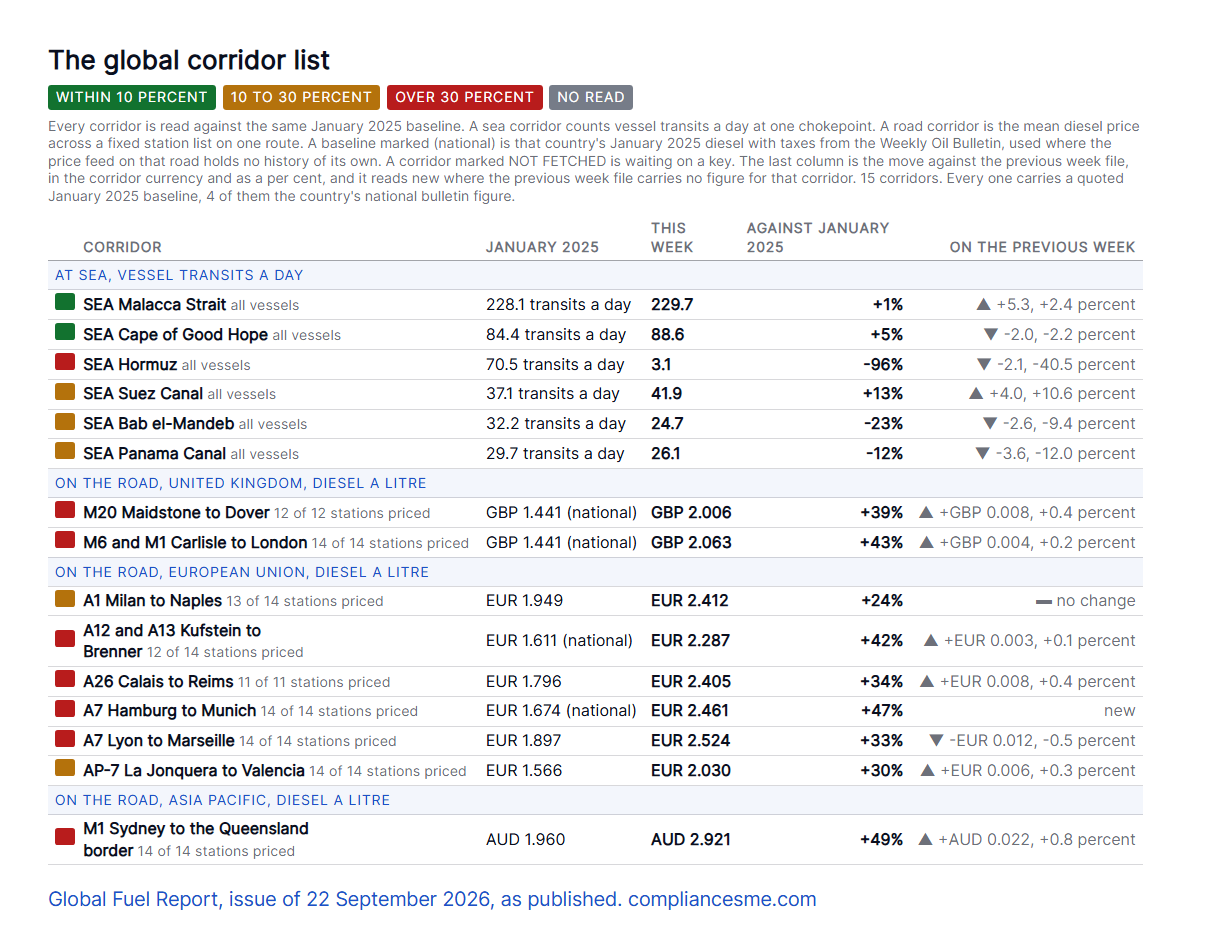
Fifteen corridors every week, each read against its January 2025 baseline: six sea chokepoints, from the Cape of Good Hope and the Panama Canal to Malacca, Bab el-Mandeb, Hormuz and Suez, and nine road corridors across France, Germany, Italy, Spain, Austria, the United Kingdom and Australia.
The standing alert thresholds, scored every week: fired, did not fire, or cannot be evaluated. An alert fires only on a figure fetched from an official feed inside the reporting week, and the line says which figure, which threshold and which source.
Global supply, the United Kingdom, Ireland, the European Union country by country, the United States, Asia, the Middle East and Gulf, Africa and Latin America, agriculture and fertiliser, health and cold chain, and defence. This week, last week, the change, the source and the date.
A named list of everything the week could not deliver, with the reason for each. Feeds that block automated reading are named as unread.
Each issue is a dated PDF, downloaded from your account. The archive stays on your account, so you keep the series and can show how a figure moved across months.
The global corridor list, 22 September 2026
The corridor list from the issue of 22 September 2026, as published: fifteen corridors, six sea chokepoints and nine road corridors, every one read this week against its January 2025 baseline, with the move on the previous week.
The pipeline board, 22 September 2026
Working 19, damaged and running reduced 0, blown up and not operational 2, blown up and gone 2, closed 5, planned maintenance 1, not read 12, across the 41 pipelines on the board.
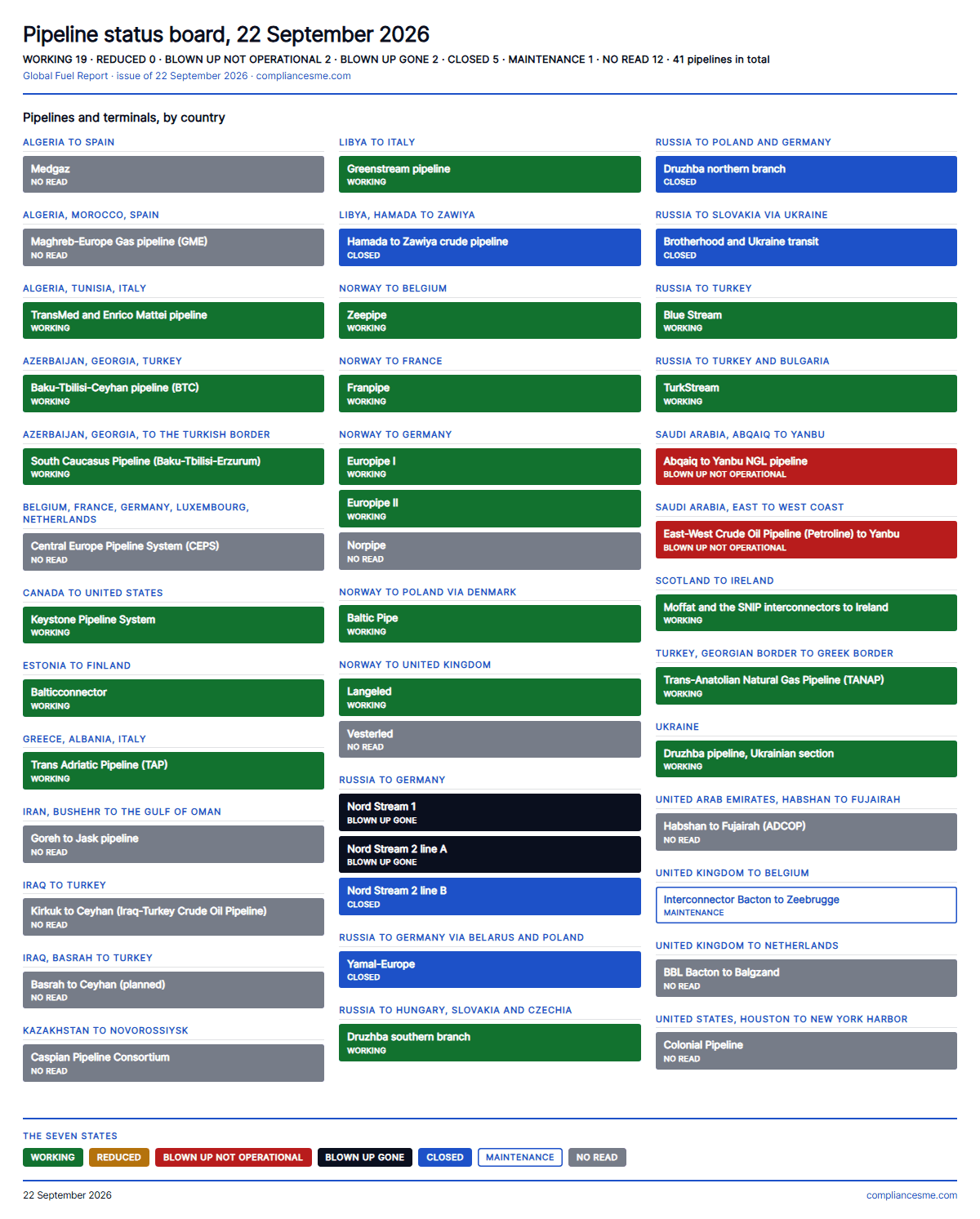
Every issue carries the corridor list for fifteen corridors and the status boards for 95 refineries and 41 pipelines, with the source and date beside every figure.
How to get it
Subscribe for £10 a month. You sign in with your email address, and each week's issue appears in your account on Friday at 07:00 UTC to read on the page or download as a dated PDF.
If you hold any paid ComplianceSME account level, Micro, Small, Medium or Compliance Complete, the report is already included and there is nothing further to pay.
The issue of 22 September 2026 is open on its page to anyone: the ten numbers, the fifteen corridors, the alerts that fired, what it could not see and every source. The numbered sections behind them download with the subscription or any paid account level.
Twenty standing questions are answered on the questions and answers page, with the questions the current issue answers at its foot.
Every issue
Each issue has its own page, open to anyone, carrying that week's ten numbers, the corridor list and the alerts that fired. The full report behind each one is the dated PDF.
22 September 2026
Global Fuel Report, 22 September 2026
Saudi Arabia's East-West pipeline has been shut since 10 September and traffic through the Strait of Hormuz fell again, to 18 vessel transits in five days against 26 the five days before, of which 3 were tankers.
Questions about the report: questions and answers. Once you subscribe, the live view sits at your fuel dashboard. Everything ComplianceSME sells: Plans.